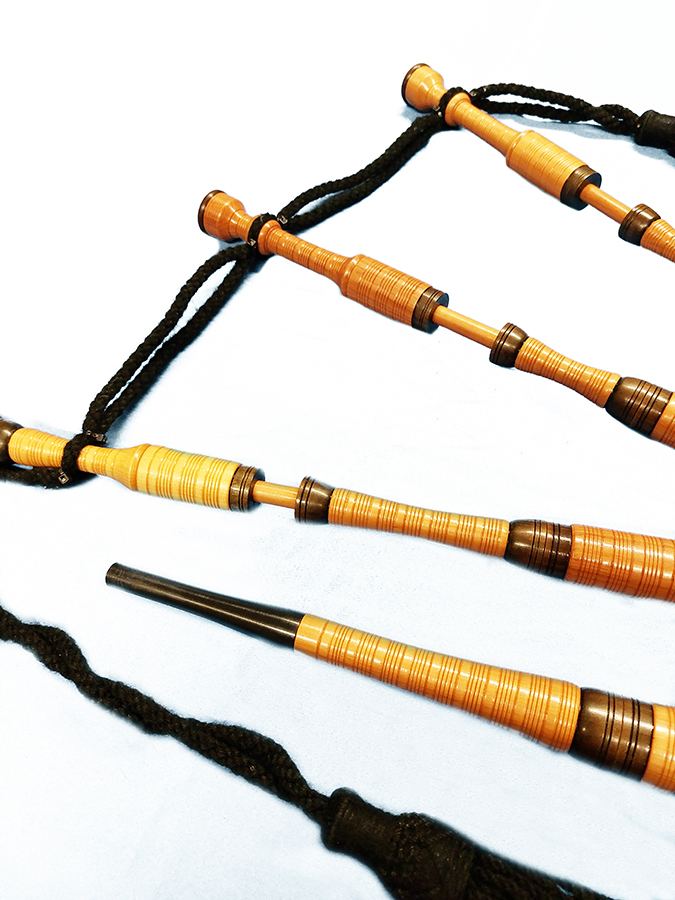
CHAMBER HIGHLAND BAGPIPE

 Description
- Sorbus Wood (Sorbus Torminalis)
- Fully combed
- Wood Pipe Chanter tuned Bb 440 Hz
- Plain Canmore GORE-TEX® Bag with ZIP
- Plastic Drone Reed
- Plastic Chanter Reed
- Black Cotton Flannel Bag Cover
- Black Wool Cords
- Soft Carrying Case
Bagpipe with a low and contained volume, for chamber, ideal to pair with string and wind instruments with a contained volume.
The Scottish bagpipe has 3 size differences: Full size Highland Bagpipes, 3/4 Size Highland Bagpipe and the Chamber Highland Bagpipe.
The measures of the 3/4 are slightly smaller than the standard model, but the volume is basically the same. The Chamber Highland Bagpipe, on the other hand, has even smaller dimensions but the sound is low and is comparable to the smallpipe one. The chanter has the same length of a standard pipe chanter and has the same spacing of the tones holes. This makes it therefore also ideal as a studio instrument.
The proposed model was conceived and completely studied by Deiv Liutaio, and is the result of years and years of tests and studies. A balance as close as possible to the Scottish bagpipe has been sought, despite having a smallpipe sound. In this respect the Highland Chamber Bagpipe proposed here is different from the Scottish Smallpipe which has different sound and measures.
 Fingering
 Frequently Asked Questions (FAQ)
1. Intended Use, Volume, and Applications
What is the Wooden Chamber Bagpipe and who is it designed for?
It is a quiet chamber bagpipe (smallpipe) crafted from fine natural service tree wood (sorbus), designed both as an excellent low-volume practice tool for the Great Highland Bagpipe (GHB) and as a fully expressive standalone musical instrument for concert performance. It offers the warm, rich, and mellow tone unique to natural wood, perfect for acoustic sessions, ensemble playing, and home practice.
How does its volume compare to a traditional Great Highland Bagpipe?
The volume level is significantly lower and perfectly balanced for indoor playing. It allows you to practice for hours without ear fatigue or disturbing family members and neighbors, while still providing the enveloping harmonic resonance and superior acoustic response of natural wood.
2. Wood Properties, Warm-Up, and Climate
Does the instrument require a warm-up period before tuning?
Yes. As with all natural wood wind instruments, it is recommended to warm up the bagpipe by playing for about 5 to 10 minutes before making fine tuning adjustments. As breath passes through and warms the wooden bore, the pitch naturally stabilizes.
How should I handle temperature fluctuations or extreme cold?
Cold temperatures cause the pitch to flatten, while heat causes it to sharpen. If the temperature drops below -5°C (23°F), playing is not recommended to avoid wood cracking or splitting due to thermal shock. Avoid sudden temperature shifts and never use direct heat sources (such as hairdryers or heaters) or direct sunlight to dry the instrument.
3. Fingering, Tuning, and Synthetic Reeds
What fingering and key does it use?
It uses standard Great Highland Bagpipe (GHB) fingering, allowing a seamless transition to and from the highland pipe. All learned technique, embellishments, and repertoire apply identically. It is pitched in B♭ at 440 Hz.
How do I tune and adjust the drones?
Drone tuning is adjusted by sliding the joints to change the length: extending the drone flattens the pitch (makes it lower), while shortening it sharpens the pitch (makes it higher). Joint wrappings must slide smoothly but remain snug with zero play, otherwise air will leak and make tuning impossible. Dedicated synthetic thread is supplied to restore joint wrapping thickness when needed.
What maintenance do the included synthetic reeds require?
Both the chanter and drones are fitted with highly stable synthetic reeds. They are unaffected by moisture, won't deform over time, and require minimal maintenance compared to traditional cane reeds.
4. Wood Care, Dehumidification, and Maintenance
What oil should I use for internal wood care?
To nourish the wood and prevent drying or cracking, oil the internal bore of the chanter, drones, and stocks 1 to 2 times a year using **100% pure sweet almond oil only**. Never use other oils or solvents. For external cleaning, never use ALCOHOL as it will dissolve the hand-applied shellac finish; clean the exterior using a soft, dry wool or microfiber cloth only.
What is the purpose of the sponges inside the drone stocks?
Inside the drone stocks are natural foam sponges that dehumidify the airflow and ensure smooth, even air delivery to the reeds. They should be removed and checked every six months. Replacement sponges are included in the package (note: sponges must never be inserted into the blowpipe stock).
What precautions should I take after finishing a playing session?
After every session, always detach the blowpipe from the stock to allow joint ventilation and prevent residual moisture from rotting the thread wrappings or cracking the wooden stock socket. Swab away any remaining internal condensation before storing the instrument.
How should the chanter be handled correctly to prevent breakage?
The chanter is the most delicate part of the instrument. When mounting or removing it from the stock, grip **exclusively by the wooden mount/bulb** near the joint. Never apply leverage or twist the middle or lower section of the chanter to prevent it from snapping.
5. Synthetic Bag, Shipping, and Included Items
What are the benefits of the included synthetic bag?
The synthetic bag provides maximum breathability, perfect airtightness, and requires zero waterproofing maintenance. It also features a convenient zipper for internal inspection, cleaning, and drying.
What is included in the package?
The Wooden Chamber Bagpipe comes complete with a synthetic bag, cover, wooden drone set, chanter, blowpipe, set of pre-calibrated synthetic reeds, replacement sponges, joint wrapping thread, and a padded protective soft case.
When does the production and delivery timeframe begin?
The indicated lead time begins upon order confirmation and the start of artisan woodworking in our workshop.
6. After-Sales Support and Spare Parts
Do you provide after-sales support and long-term maintenance?
As a direct artisan workshop, we provide ongoing after-sales support for all our instruments. We offer tuning and reed adjustment assistance, dedicated spare parts, joint wrapping thread, and long-term wood repair or restoration services.